Analysis
Miles McBride: The Two-Way Anchor Stabilizing New York's Reserve Backcourt
Miles McBride's ferocious point-of-attack defense, lethal spot-up shooting, and low-turnover poise give the New York Knicks an indispensable bench anchor.
Championship contenders are often defined by the brilliance of their All-NBA starters, but titles are sustained by the reliability of their rotation depth. For the New York Knicks, fourth-year guard Miles 'Deuce' McBride represents the gold standard of developmental success and rotational value. From second-round draft pick to core playoff contributor, McBride has transformed himself into an indispensable two-way weapon.
As head coach Mike Brown implements an elevated offensive pace and versatile defensive schemes ahead of the 2026-27 campaign, McBride's role becomes even more central. His ability to disrupt opposing lead guards for 94 feet while spacing the floor with efficient perimeter shooting provides New York with steady two-way production whenever Jalen Brunson rests.
SNY's Ian Begley: Miles McBride on wanting to finish his career in New York.
94-Foot Point-of-Attack Defensive Tenacity
McBride's calling card has always been his relentless defensive intensity. Equipped with a 6-foot-9 wingspan on a compact frame, lateral quickness, and exceptional core strength, he routinely suffocates opposing ball-handlers before they can cross half-court.
In Mike Brown's defensive system, which emphasizes aggressive point-of-attack disruption and rapid recovery rotations, McBride functions as a tone-setter. Rather than dropping into passive containment, McBride picks up opposing primary creators full-court, burning precious seconds off the shot clock and forcing opponents to initiate sets far from the three-point arc.
His screen navigation is equally impactful. McBride consistently fights over high ball screens with disciplined technique, staying attached to shooters and taking away pull-up opportunities without fouling. This perimeter containment allows New York's backline rim protectors, Karl-Anthony Towns and Mitchell Robinson, to stay anchored in optimal rebounding positions.
The Catch-and-Shoot Leap and Perimeter Spacing
While McBride entered the league with defensive pedigree, his offensive transformation has unlocked his full rotational value. McBride has developed into one of the most reliable corner and wing catch-and-shoot specialists in New York's arsenal:
- Lethal Spot-Up Accuracy: McBride converted over 40 percent of his catch-and-shoot three-pointers over the past two seasons, punishing defenses that cheat off the weak side.
- Rapid Release Mechanics: McBride has shortened his shooting dip and quickened his release, enabling him to fire cleanly against contested perimeter closeouts.
- Low-Turnover Decision Making: In high-pressure bench minutes, McBride takes care of the ball, with 106 assists against 33 turnovers in 41 games last season (2.6 assists to 0.8 turnovers per game, per Basketball-Reference), making quick swing passes rather than forcing risky isolation plays.
Dual-Guard Lineups and Secondary Creation Under Mike Brown
One of the key tactical strengths McBride provides is his seamless scalability. He is equally comfortable operating as the sole point guard in bench heavy lineups or sharing the backcourt alongside Jalen Brunson, Tyler Kolek, or Josh Hart.
When paired with Brunson, McBride slides effortlessly into the off-guard role, spacing the floor in the weak-side corner while taking the toughest perimeter defensive assignment. When running the reserve unit with rookie or second-year playmakers like Kolek, McBride's off-ball movement and relocation shooting provide an easy release valve against collapsing defenses.
Mike Brown's possession-focused offense prioritizes rapid ball movement and early clock three-pointers. McBride's readiness to shoot off dribble-handoffs and pistol actions fits hand-in-glove with the Knicks' modern tactical identity.
Playoff Trust and Long-Term Core Stability
McBride's contract extension stands as one of the best value deals across the entire NBA. By locking in a high-impact, playoff-tested guard on a team-friendly pact, the Knicks secured vital salary-cap flexibility while preserving backcourt continuity.
In postseason environments where rotations shrink and defensive flaws get targeted ruthlessly, McBride remains a fixture in high-leverage closing units. Whether guarding explosive scoring guards or hitting timely corner triples, Miles McBride provides the fierce two-way stability that championship dreams are built upon.
Questions readers are asking
What makes Miles McBride such an effective point-of-attack defender?
McBride combines a 6-foot-9 wingspan, rapid lateral quickness, and exceptional screen navigation to pressure ball-handlers full-court and disrupt offensive rhythm without committing unnecessary fouls.
How has Miles McBride's offensive game evolved?
McBride has developed into a reliable 40-percent catch-and-shoot three-point threat with a quickened release, allowing him to punish weak-side help and space the floor in multi-guard lineups.
Can McBride share the floor with Jalen Brunson?
Yes. McBride fits seamlessly alongside Brunson by guarding the opposing team's primary scorer on defense while operating as a floor spacer and secondary decision-maker on offense.
How does Mike Brown utilize McBride in the Knicks rotation?
Coach Mike Brown uses McBride to maintain high defensive intensity across 94 feet, push early transition pace off forced turnovers, and execute perimeter handoff actions.
Keep reading
Related coverage
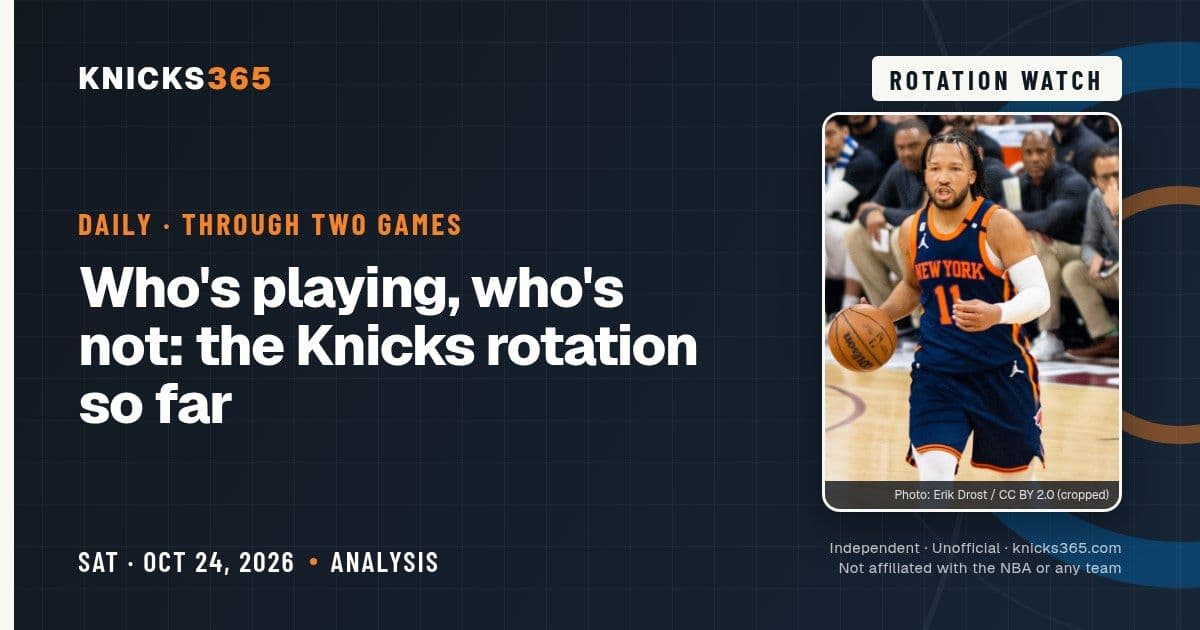
Rotation Watch: Who's Playing, Who's Not Through Two Games
Same starting five, a McBride surge, a Drummond squeeze and three DNPs twice. Every Knicks minute through two games, and what I make of it.
Inside New York's Final Roster Battle: Balancing Wing Versatility and Frontcourt Size
Mike Brown and the Knicks front office face a pivotal decision for the 15th roster spot, weighing defensive wing versatility against backup interior size.
Jalen Brunson and Karl-Anthony Towns: The Two-Man Game Unlocking New York's Offense
The Jalen Brunson and Karl-Anthony Towns two-man partnership creates an impossible pick-and-pop dilemma that supercharges New York's half-court ceiling.
Sources
- NBA.com Official Knicks Roster and Player Profiles
- NBA.com Official Tracking Stats and Catch-and-Shoot Data
- New York Post Knicks Rotation and Roster Analysis
- New York Daily News Knicks Training Camp and Backcourt Coverage
- Basketball-Reference: Miles McBride stats
See an error? Email team@knicks365.com.
