Analysis
Jalen Brunson and Karl-Anthony Towns: The Two-Man Game Unlocking New York's Offense
The Jalen Brunson and Karl-Anthony Towns two-man partnership creates an impossible pick-and-pop dilemma that supercharges New York's half-court ceiling.
Championship offenses are built on unstoppable two-man combinations. When the game slows down in high-stakes fourth quarters, every elite team must possess a primary action that forces defenses to pick their poison. For the New York Knicks, that foundation is the elite two-man synergy between All-NBA captain Jalen Brunson and four-time All-Star Karl-Anthony Towns.
As head coach Mike Brown integrates his pace-and-space offensive philosophy ahead of the 2026-27 season, the Brunson-Towns partnership serves as the engine of New York's half-court attack. Combining Brunson's surgical paint penetration with Towns' historic perimeter shooting, the duo presents an unsolvable coverage riddle for opposing defensive coordinators.
The Knicks on Karl-Anthony Towns' 2026 playoff shooting splits.
The Pick-and-Pop Coverage Dilemma
The primary friction point of defending Brunson and Towns lies in traditional pick-and-roll defensive schemes. In standard NBA coverages, opposing centers drop into the paint to protect the rim against penetration, while guards fight over screens to contest pull-up jumpers:
- The Failure of Drop Coverage: If the opposing big man sags into the paint to deter Brunson's patented floater, Towns pops to above the break with acres of space. Shooting over 40 percent from distance on high volume throughout his career, Towns punishes drop coverage with ruthless efficiency.
- The Peril of Trapping or Blitzing: If opposing defenses aggressively blitz Brunson to get the ball out of his hands, Brunson's short-roll delivery to Towns creates a 4-on-3 advantage where Towns can shoot, drive, or hit corner shooters Mikal Bridges and OG Anunoby.
- The Switching Mismatch: If opponents switch across positions, Brunson isolates against slower centers on the perimeter, while Towns seals smaller perimeter guards deep in the low post.
Inverted Screening and Playmaking at the Elbow
What elevates the Brunson-Towns dynamic beyond a conventional guard-center screen action is their role versatility. Mike Brown has installed inverted screening packages that feature Brunson setting back screens for Towns at the high post and elbow.
When Towns receives the ball at the nail, Brunson immediately flows into a ghost screen or dribble hand-off action. Defenses that overcommit to Towns' face-up scoring threat leave Brunson streaking downhill toward his preferred left-hand layup angles. Conversely, when defenses pinch inside to prevent Brunson's drive, Towns steps into rhythm elbow jumpers or fires skip passes to weak-side cutters.
This constant movement eliminates stagnant isolation possessions, ensuring that New York's primary stars generate high-value looks early in the 24-second clock.
Spacing the Floor for Wing Slashers
The gravitational pull of the Brunson-Towns tandem creates wide-open driving lanes and corner looks for the supporting cast. With Towns pulling opposing rim protectors 25 feet away from the basket, the lane remains open for aggressive downhill attacks from Josh Hart and Mikal Bridges.
Corner specialists and secondary playmakers benefit directly from the defense's panic rotations. When help defenders are forced to leave their assignments to help on Brunson or rotate to Towns on the perimeter, the ball moves quickly along the perimeter, producing uncontested catch-and-shoot opportunities.
Late-Clock Crunchtime Reliability
In the postseason and close regular season games, offensive sets inevitably break down under intense physical ball pressure. Having two premier scoring options capable of generating high-percentage attempts from all three scoring levels provides the Knicks with unmatched late-game composure.
Whether executing a high pick-and-pop, an elbow hand-off, or an isolated mismatch, Jalen Brunson and Karl-Anthony Towns give New York the half-court firepower necessary to compete for championships in modern NBA basketball.
Questions readers are asking
Why is the Brunson and Towns pick-and-pop action so difficult to defend?
Defenses cannot rely on traditional drop coverage because Towns shoots over 40 percent from three-point range, while switching or blitzing exposes mismatches for Brunson's elite isolation and playmaking.
How does Mike Brown utilize inverted screening with Brunson and Towns?
Mike Brown incorporates sets where Brunson screens for Towns at the elbow and high post, creating ghost screens and dribble hand-offs that disorient defensive communication.
How does Towns' shooting gravity help other Knicks players?
By pulling opposing rim protectors out to the three-point line, Towns clears the paint for downhill drives by Mikal Bridges and Josh Hart, as well as kick-out threes for OG Anunoby.
What makes this two-man combination effective in crunchtime situations?
Both players can score efficiently from all three levels and make high-IQ passing reads under pressure, preventing late-game offensive stagnation.
Keep reading
Related coverage
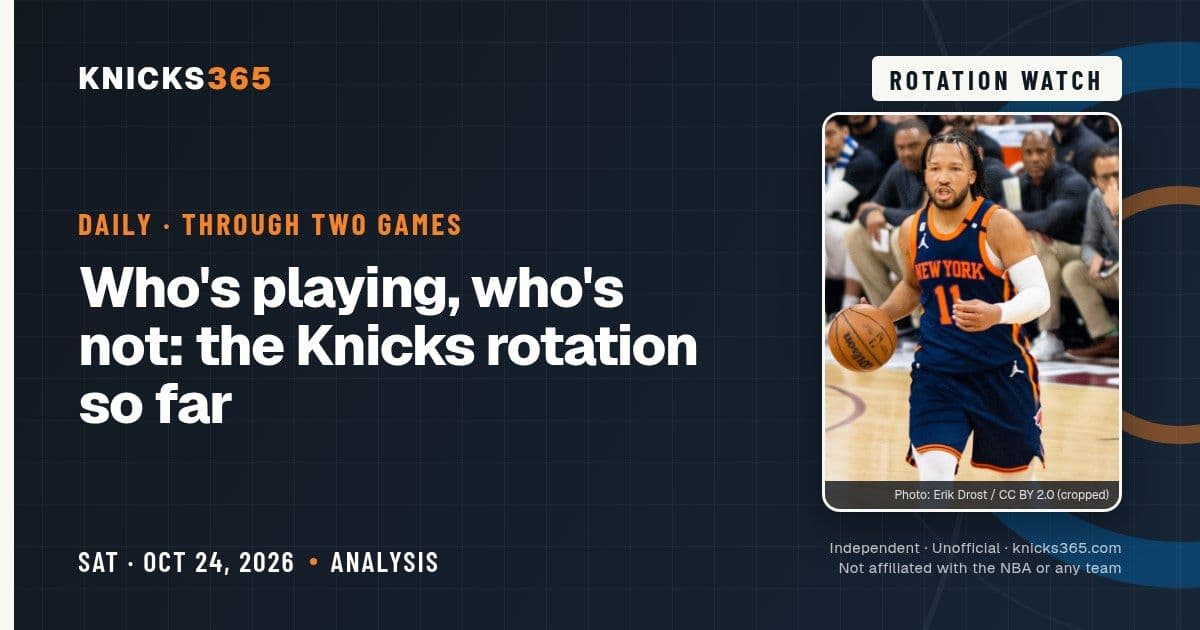
Rotation Watch: Who's Playing, Who's Not Through Two Games
Same starting five, a McBride surge, a Drummond squeeze and three DNPs twice. Every Knicks minute through two games, and what I make of it.
Inside New York's Final Roster Battle: Balancing Wing Versatility and Frontcourt Size
Mike Brown and the Knicks front office face a pivotal decision for the 15th roster spot, weighing defensive wing versatility against backup interior size.
Tyler Kolek: Rim Aggression and Paint Playmaking in Mike Brown's Offense
Tyler Kolek's aggressive downhill rim finishing and sharp paint playmaking provide the New York Knicks with an evolving offensive spark off the bench.
Sources
- NBA.com Official Knicks Roster and Player Stats
- NBA.com Advanced Tracking Stats and Pick-and-Roll Data
- New York Post Knicks Offensive Analysis and Training Camp Coverage
- The Athletic NBA Half-Court Efficiency and Spacing Metrics
See an error? Email team@knicks365.com.

